Category Archives: Uncategorized

Season’s Tidings

We stop mowing the lawn and start raking the leaves. And eventually shovel some snow. Some of us take the AC unit out of the window and start making fires in the fireplace or woodstove. We put away the shorts and t-shirts, and get out the jackets and boots.

Regardless of what you do when winter sets in, you know life doesn’t end or suspend. We don’t go into hibernation. Only the activities change.

The same is true for Garuda Aviary. When it gets too cold for the flock to enjoy the outside flight cage, the visitor area is closed and we stay inside until spring. But by no means are the lives of our many flock members suspended in any way. Parrots never “take a holiday” from needing food. They never “take a break” from craving stimulation and social interaction. They never “go on vacation” from requiring care and maintenance. So every day, we at Garuda Aviary provide our parrots with everything they need to be happy and healthy.

Winter also provides the opportunity to get some inside work done. Last winter, we started a GoFundMe social fundraising campaign to raise funds for specialized cage building material.  Thanks to you, we have partial funds and can now begin expanding a few habitats. These custom-built habits will offer maximum space and social interactivity, allowing our parrots to live as nature intended; in breed-specific flocks.

Please note: As we have not raised the total amount needed for the cage building material, if you would like to contribute to our habitat expansion project, please go to https://www.gofundme.com/NewCages

No matter the season, Garuda Aviary strives daily to improve the lives of Parrots. However, we cannot do it alone. We need your help!  Please consider giving a year-end contribution, which will make an meaningful impact and allow Garuda Aviary to provide outstanding lifelong care and shelter for our Parrots.  Comfort and happiness is the greatest gift you could give!


Garuda Aviary is a non-profit 501 c 3 organization.  All contributions are fully tax deductible in accordance with Federal and State Laws.
Rich Diet = Naughty Bird

One of our faithful viewers had a number of questions regarding diet for the Parrot Whisperer.

Q: Hi there!! I have a yellow naped Amazon, female. I am very interested in learning more about the diet you feed your birds.  How do you prepare the food and how do you get your birds to eat raw vegetables. My bird likes hers cooked.  She also gets a nut, seed and pellet mixture.  She rarely eats the pellets. Should I limit the seeds and nuts?

A: Thank you for writing in. You are asking the questions that a responsible, caring parrot owner asks.

Understanding that diet is one of the biggest factors that determines how a parrot behaves brings us closer to understanding this animal better entirely.

First, let’s look at what parrots do without humans involved.

Any parrots natural habitat will have a season when the region’s flora produces bountiful food resources such as fruit, seed, and nuts. That region’s animal life, including parrots, will gorge themselves on these resources to stock up as many calories as they can claim. When this happens, a parrots drive to mate becomes much stronger. The parrots body is responding to the instinct to bear young when resources are plentiful. They become aggressive because they need to fight off competitors and find a mate.

For the remainder of the year when fruit, seed and nuts are not available, a wild parrot will have to rely on vegetable plant life for sustenance. As food resources become scarce, a parrots body knows that bearing young and keeping them fed will be too difficult. As a result, the parrots desire to mate decreases.

When a parrot in a domestic setting gets too many rich calories, (oils from seed & nuts and sugars from fruits) they are aggressive, combative, demanding, needy, neurotic, etc…

Ultimately, their diet should be mostly vegetable and pellets. Fruit is ok, but it must be balanced with the vegetables. Parrots should get more vegetables then fruit. We will also talk about beans (as a non-rich source of protein).

I understand that it can be challenging to provide a variety of fresh veggies on a daily basis, but fresh would be much better then frozen or cooked. Frozen always has extra sodium and cooked has lost many of it’s nutrients.

Raw veggies are the cobblestones on the road to a happy, healthy parrot. Raw broccoli, (for example) has N-acetyl-Cysteine. That’s an amino acid used to treat people afflicted with trichotillomania, which is the human version of feather plucking.

Recommended veggies; Green beans, cauliflower, broccoli (crown and stem), yellow squash, zucchini, carrots, radishes, celery.

Beans; Add kidney beans, lima beans, lentils for non-rich protein. Beans should be served al dente, not mushy.

NO soybeans. They are estrogenic (promoting or producing estrus).

Recommended fruits; banana, grapes, blueberries, apple, orange. Again;  fruit must be served in moderate amounts. Vegetables must far outweigh the fruit.

Too much of the seed mix is a problem. If they get too much of the mix, they will satisfy themselves on the seed exclusively and disregard the pellets. Pellets are very important. Often a lack of key vitamins and minerals can set a parrots mental and emotional state off balance. The pellets will provide those vital nutrients.

Pellets should usually be accessible. ZooPreem is good. I recommend always having a bowl of ZooPreem medium/large sixed pellets in her cage, on her stand, wherever…

Calcium is important. A trick I learned some time ago is that calcium antacids make a nice treat. Make sure that calcium carbonate is the only active ingredient. Get fruit flavored and give her 3-6 a week…

Do you have a question for the Parrot Whisperer? Let us know at GarudaAviary.org

Birds of a Feather…

Dont't always flock...

Sara, (a long time friend of Garuda Aviary) had this question for the Parrot Whisperer…

Hello Garuda 😉

How do parrots like mine who are used to people and lots of human touch, interaction and affection, adapt to a sanctuary?

My parrot is used to lots of petting and is very well socialized. I take her almost everywhere with me, in the car, etc. She lets my friend pet her and loves human interaction. She is almost NEVER aggressive because she’s been well nurtured as a baby.

I take her to be around other birds. She’s cool with it, but does not really engage with them. I don’t think she sees herself as a bird, but as a human with feathers.

How do you transition a parrot to be with other parrots? How do domesticated birds transition to your sanctuary?

Thank you! (Many blessings)
Sara


Hi Sara!

I always love to hear about parrots with loving owners. Your bird is truly blessed.

First I must correct you on one misconception; there is no such thing as a domesticated parrot. Domestication takes much longer to occur then humans have been keeping parrots as pets. However, they can seem tame because they are intelligent and can learn how to live around humans. But make no mistake. They are wild captive prey.

That being said…

When a parrot bonds with a human, (like you and your bird) that is possible because they are animals that gather in groups like we are. In this kind of situation, the parrot considers the owner as a parent or flock leader. Parrots are generally loyal to their flock and to their flock leaders. They do not leave their flock to go and hang out with another flock. The other flock wouldn’t want them around anyway because it’s another mouth to feed.

This is essentially why when you bring your bird around other parrots, he’s not interested in engaging with them. He has a flock; You (and your other pets, friends, and family, etc). It’s not in a parrot’s nature to leave their flock and seek out another.

So as long as you’re truly there for him, then he has all he wants. Your parrot would think that hanging out with another established flock would only cause trouble.

Now… your question about socializing a parrot with another flock (like when a new bird arrives at a sanctuary) can be a difficult one.

When we rescue a parrot from a cruel situation, they almost never had a flock there… or good food, toys, lots of room to play, full spectrum lighting, etc.… So those poor birds are fairly easy to make happy. They want to join our flock because they feel naked without one. They tend to LOVE everything we do for them.

However, when a parrot that comes from a good home is relocated to a sanctuary, they are usually very unhappy about it for some time. They miss their flock and they want to go back to them. The memory of their previous flock, (and their desire to rejoin them) keeps them from engaging with the new flock.

A parrot does not choose to engage with another flock. But when it’s re-homed to a sanctuary, it is forced to do so. If it longs to return to its previous flock, then the transition may be long and unhappy.

If your parrot isn’t crazy about socializing with other parrots, that’s ok. Trust me, there are worse parrot problems than that. Just be happy that he adores you and wouldn’t want to be with anyone else.

Good question, Sara
Thanks!

Christopher Zeoli
Director
Garuda Aviary

Protecting Polly

by Emma Dacol,
AWOL Magazine

CREATING A HAVEN FOR ABUSED PETS

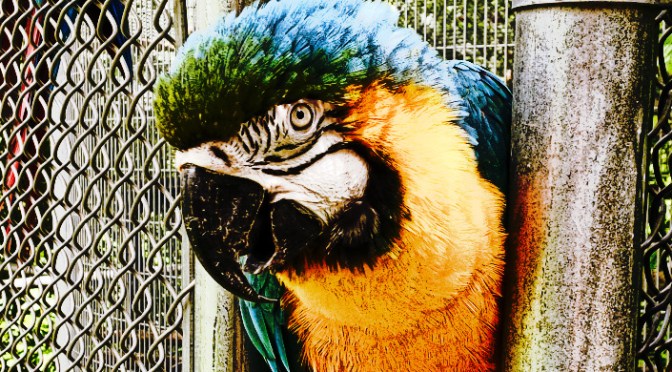
Alex is a Blue & Gold macaw. His owner, Claire Exten, volunteers at the Garuda Aviary in Poolesville, Maryland. The nonprofit sanctuary shelters abused and neglected parrots. She has been volunteering at the aviary for about a year and a half. She explaind that since working for the aviary, she has learned a lot about parrot behavior and nutrition. She has also improved her relationship with Alex.

“We have a much better relationship. He’s more level headed most of the time,” Exten said. “He still has his parrot days where he goes crazy; he’s still a macaw, but then when he goes off the deep end or whatever, I understand why. He’s just being a parrot.”

Christopher Zeoli is the director of Garuda Aviary. He says parrot owners are far more likely to abandon their birds rather then keep them for their entire lives. Like many parrot sanctuaries across the U.S., the Garuda Aviary started by accident. Zeoli and his mother adopted one parrot and started taking in other abandoned parrots. Before they knew it, they had a reputation. The birds started flocking in.

According to Zeoli, 98 percent of parrots sold as pets come from abusive parrot mills. There, parrots are squished into tiny cages, kept in total darkness and fed an unnaturally rich diet to induce breeding. The diet often leads to heart attacks and strokes. Through his work, Zeoli hopes to increase awareness about parrot welfare and conservation, helping people recognize that parrots are wild animals and do not belong in captivity. However, for those to insist on keeping the birds as pets, Zeoli wants to educate parrot owners about proper care.

Approximately one-third of parrot species in the wild are endangered due to habitat destruction and the trade of wild caught parrots, while millions of wild parrots kept as household pets are discarded. The Wild Bird Conservation Act 1992, banning the import of wild caught birds into the U.S. But illegal poaching and captive breeding of parrots for the pet trade has continued.

Some argue that the that humane breeding of parrots in captivity reduced the demand for illegal caught birds.  However, Zeoli argues that because it is so difficult to get parrots to reproduce in captivity, it is impossible to treat parrots humanely and still run an economically viable breeding business. The natural lifespan of a macaw is between 50 and 90 years. And in the wild, they live in flocks and form intensely monogamous relationships with their mates. In captivity, the try to replicate these relationships with their owners. Parrots living with a human family may identify them as it’s flock. And in some situations, they will form a mate-like bond with one person, which can very problematic. The parrot can become violent with the person’s significant other or children.

Parrots exhibit remarkable intelligence. Irene Pepperburg, an adjunct professor of psychology at Brandeis University, proved that an African Grey parrot has intelligence levels similar to that of a human child.

Parrots experience isolation in captivity and are usually not allowed to fly. They feel stress which leads to self-mutilation in the form of feather plucking, similar to human obsessive-compulsive disorders.

In contrast to the media’s false image of the playful, friendly parrot, most parrot owner find their parrots difficult to manage due to the noise and aggression, and they give them up. Because of the intense bonds parrots form with their owners, transferring homes can be very traumatic.

Zeoli hopes that the government will put an end to the domestic breeding of parrots and that trade of wild-caught parrots will stop before all macaw species go extinct. He says that working at the aviary and seeing the trauma and suffering experienced by so many birds on a daily basis is “the most emotionally taxing thing I’ve ever done,” but that rehabilitating the parrots and making a difference in their lives makes it all worth while.


Emma Dacol is a graduate student pursuing an MFA in film and electronic media

AWOL (American Way of Life) Magazine is an award winning progressive publication run by American University students

AWOL Magazine is not affiliated with any political party or ideology.

See the original article at http://issuu.com/awol/docs/awol_s15_issuu/4  (but please hurry right back!)

New Family

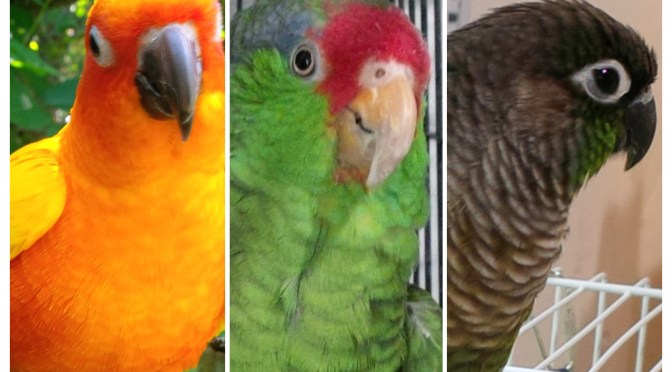
Garuda Aviary is happy to welcome Rosie, Green Guy & Bernard into our flock.

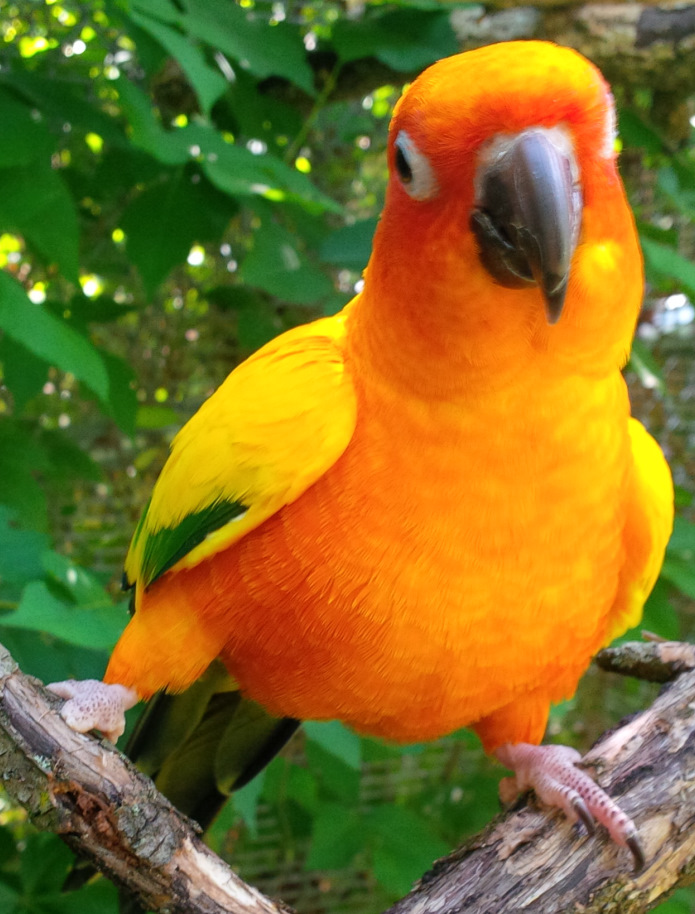
rosie.croppedRosie is a spirited and energetic Sun Conure. While otherwise physically normal, she has a deformed foot with only one rear toe. But she doesn’t let that slow her down. Rosie calls relentlessly for attention and will climb up the arm and onto the shoulder of anyone that responds.

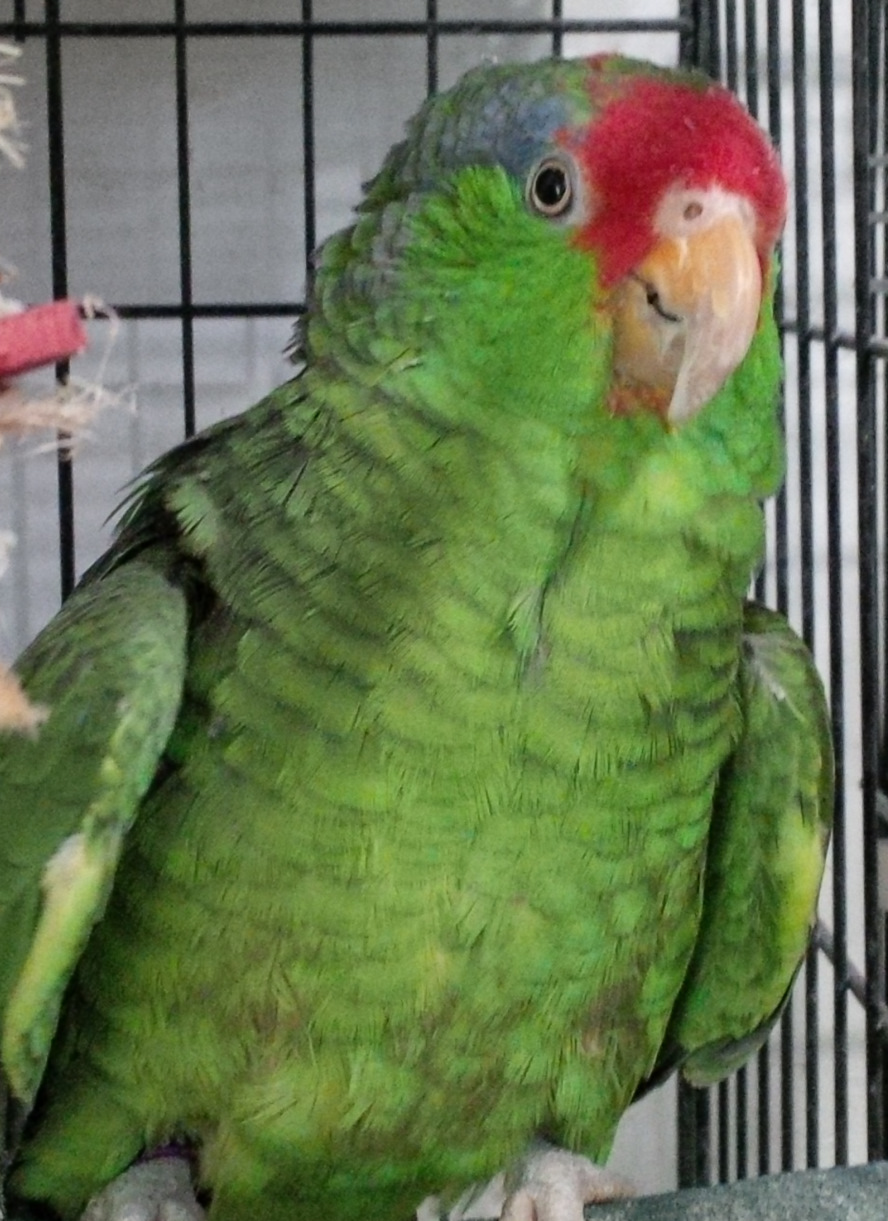
Green Guy is a shy and reserved Red Crowned Amazon that does not “step up” (perch on a human’s hand) and does not like to be touched. He’d rather stay in the back of his cage and play with his toys. But like most Amazons, Green Guy has a large repertoire of curious calls and noises.green guy.croppe

Rosie and Green Guy were the last two occupants in a home that was being foreclosed. When a kind couple came to look at the empty and unheated house, they found these two parrots in a dimly lit room. The owner offered them to the couple for free because they were all about to become homeless.

Green Guy was not eating well due to of a mildly deformed beak. The new foster parents took him to the vet to have his beaked reshaped. After his beak was corrected, Green Guy ate and ate and ate… and hasn’t slowed down yet.

Their foster parents knew that they could only take proper care of these two for a limited time. An exhaustive search for the proper home led them to Garuda Aviary.

I have been looking at sanctuaries and yours resonated with me. I love the fact that the parrots are accepted as they are and can spend their lives being themselves.”

Rosie & Green Guy’s foster mother


We at Garuda Aviary would like to thank this compassionate couple for opening their hearts and securing a positive future for these sensitive and deserving creatures.


Bernard

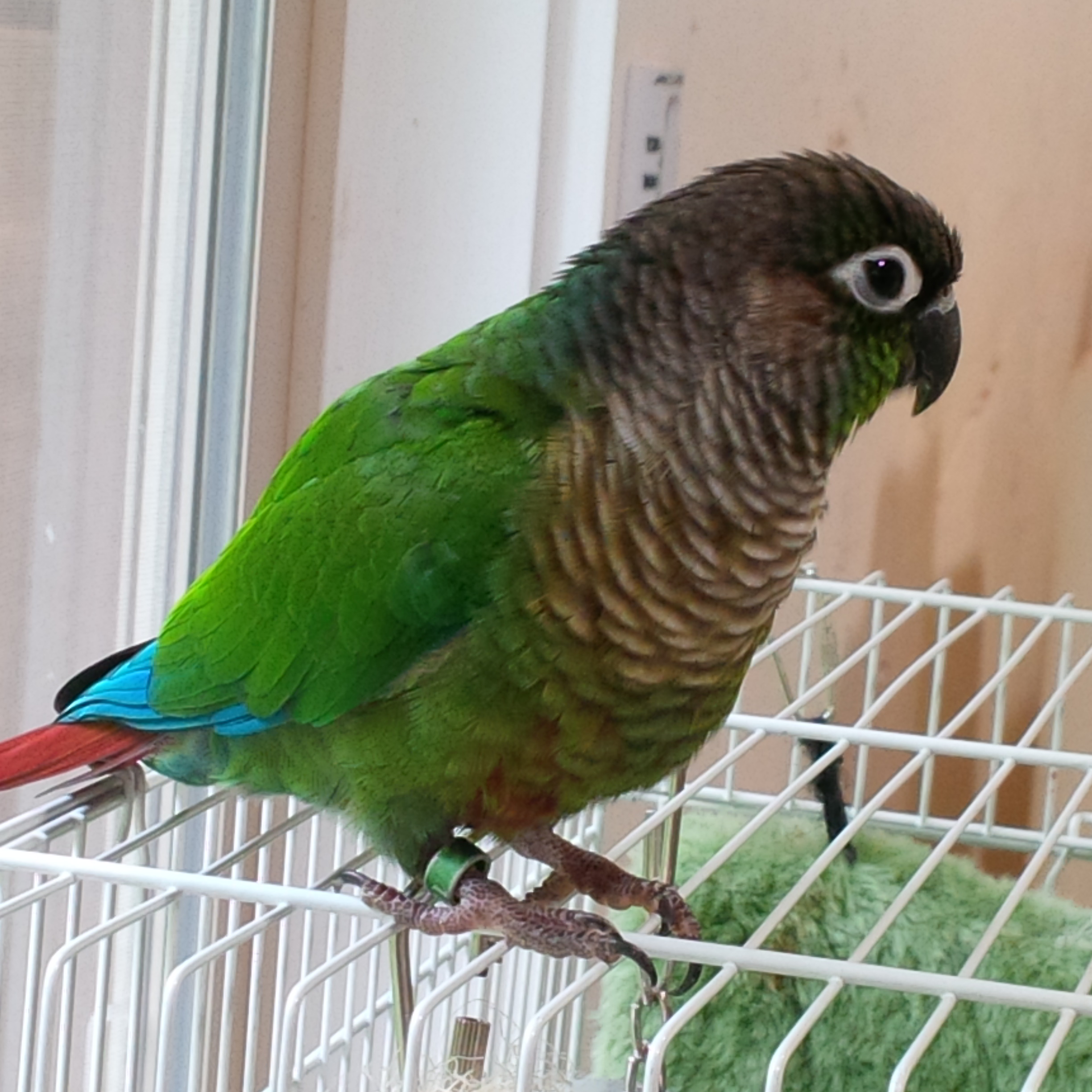
Meet Bernard. He’s an adorable little Green Cheek Conure. But this little guy has a big problem. His temper! He bites with enough ferocity and aggression to make caring for him very difficult.

BernardBernard’s owners were at their wit’s ends trying to give him a good life. His aggression made interaction nearly impossible.
Our Director Christopher Zeoli feels that; “Bernard needs very specific social indicators. These social “instructions” are best when provided by a group of similar parrots. Often parrots have social dysfunction because they never learned how to interact with a flock. A flock offers its members easy to recognize social cues that teach them how to work as a group.”
Bernard has special needs. Garuda Aviary is here to provide special care.

The Wild Cockatoo Heart

By Christopher Zeoli

If you are familiar with parrots, then you have probably heard about some of the problematic issues they develop in a domestic setting. Anxiety and boredom leading to feather plucking, skin mutilation and outrageous, terrible behavior. Ear splitting screaming and the receipt of bite wounds are commonplace occurrences for parrot owners.

But let’s try to make this image as clear and specific as we can. Do all types of parrots struggle with these problems? Certainly all types of parrots considered to be pets living in a domestic setting will begin to pull out their own feathers at some point in their lives. The screaming and biting is also par for the course when living with or handling parrots. But what about the skin mutilation? Will all examples of Cockatoo skin mutilation are easy to find.types of parrots eventually mutilate and destroy their skin, placing their own lives in danger from infection? Usually not. The type of parrot most known for this extreme and horrific behavior is the Cockatoo. All breeds of Cockatoo. If you look around hard enough, you can find a few occasional cases in non-Cockatoo parrots. But the vast examples of Cockatoo skin mutilation are easy to find.majority of skin mutilation is found within the numerous breeds of Cockatoo. But why are they so affected?

Another disturbing phenomenon one may witness while handling and caring for parrots is seizures. Certain types of parrots will experience seizures triggered by elevated levels of stress. Can you guess what kind of parrot is most commonly known to suffer from stress-related seizures? That’s right; Cockatoo. All breeds of Cockatoo. Again, you can find occasional instances of seizures in other types of parrots. But those cases always involve some pathology (disease). In other words, for a non-Cockatoo parrot to have a seizure, it must be sick or have a disease. The majority of seizure activity plaguing Cockatoos does not involve disease. These we call non-pathological seizures. Put simply, most Cockatoos are always so nervous, that it doesn’t take much additional stress to send them into a seizure. Now, I realize it is hard to look at a Cockatoo in the throes of a seizure and imagine that there is no disease at work. But a thorough and exhaustive medical examination will find nothing out of the ordinary in the bird’s anatomy or physiology that is causing the seizures. The suspicion of pathology is further dismissed if the phenomenon is seen as commonplace for the breed. And in this case, it is. Please note however, that anxiety or nervousness does not necessarily equate to fear. A Cockatoo may sometimes seem calm, not experiencing fear per se. But its anxiety levels are still naturally very high.

When trying to find why Cockatoo parrots suffer uniquely, observing one breed in particular may lead us closer to an answer.

All parrots are prey. And prey’s typical response to a threat is to flee. But not the Medium Sulphur Crested Cockatoo. In the wild, these birds have been known to mob-attack encroaching raptors. They have also been observed dropping stones and small branches into bat’s lairs in an unprovoked attempt to evict the bats from their territory. Sulphur Crested Cockatoo generally do not flee threats. Cha-Chi.croppedThey throw themselves at it in attack mode. This very aggressive fear response serves the Sulphur Crested quite well in their wild habitat. But when we try to make this animal into a pet, the delicate natural balance of a hyper-aggressive prey is thrown off.

Now let’s take a moment to stretch our minds back to some obscure television programing. Do you remember the police serial Beretta? Robert Blake (of Little Rascals fame) played a police detective that owned a Medium Sulphur Crested Cockatoo named Fred. Fred was cute, smart, precocious and so very personable. He appeared to make the perfect pet. Actually, Fred was played by several different Sulphur Crested Cockatoos. Whenever one of the parrots playing Fred developed an anxiety disorder or began to pluck out its feathers, it would be replaced with a younger Sulphur.

Because the show Beretta portrayed Sulphur Crested Cockatoos as such great pets, the popularity of these birds quickly increased. The demand went up and the market rose to the occasion, supplying Sulphur’s to an unwitting public. But after these birds were brought home by ill-prepared owners, the bird’s true nature would invariably emerge. Because they are not fond of feeling cornered, these parrots can be shockingly aggressive when confined to cages. The ensuing bites, injury and bloodshed would usually result in the Sulphur’s removal from the home.

This phenomenon is what I call the “101 Dalmatians Scenario.” Popular media makes an animal appear desirable as a pet. The animal becomes popular, but that popularity crumbles as owners encounter how difficult the animal is to own. The result is that unmanageably high numbers of the animal are abandoned in a short period of time. Rescues and sanctuaries quickly fill to overflow, and the “unlucky ones” are largely euthanized.

Even without the dramatic spiral of the Dalmatians Scenario, the difficulties Cockatoos endure in a domestic setting are obvious. Would you like to guess what type of parrot is most frequently abandoned? I’ll give you a hint; it’s a type of Cockatoo. The Umbrella Cockatoo.

The popularized image of the Umbrella Cockatoo is a parrot that is smart, precocious and personable. Sound familiar? It also mimics human speech very well, which leads us to mistakenly anthropomorphize it. When a parrot has a good capacity for imitating speech, we expect it will be like owning a small feathered human. Thusly, we oppress the bird with social expectations that we would only place upon other humans. While the Umbrella Cockatooplucked girls is very smart, and can be very personable, the fact remains that it is a wild animal which originates from an unforgiving natural habitat. When an Umbrella feels threatened, it is remarkably effective at defending itself by delivering bites that may require medical attention.

From Australia to the Indonesian Islands, Cockatoos evolved in harsh conditions replete with skilled and dangerous predators. In these natural environments, only the most attentive prey survive. Even a momentary lapse in vigilance can be fatal. We humans blithely ignore the fact that it is a wild animal by bringing them home and confining them to cages. The excruciating boredom of captivity paired with relentless, unmitigated anxiety causes a Cockatoo’s mental and emotional balance to unravel. This is why we see such extreme non-pathological problems in captive Cockatoos.

If I could have one magic wish granted that would help all parrots, I would wish humans realized that a parrot in a cage is no better off than a dolphin in a bathtub. I would wish this for the benefit of all parrots. But I might wish it mostly for the salvation of the wild Cockatoo heart.


How do you control feather dander?

One of our Twitter followers recently asked if we manage dander by bathing the birds a lot. The root of the question refers to the copious volume of dander that parrots (especially cockatoos) produce.

As you may recall from our blog post, Do you love dust and dander?, Garuda Aviary’s flock creates more dander in a week then the average household creates in a year. In one year, our flock produces more than 6 pounds of dander! That much dander can completely occlude air filters and destroy a building’s HVAC compressor. Not to mention the damage it can cause in the lungs of mammals and rainforest parrots. So our questioner is wondering how we manage all that dander. Good question!

Frequent misting showers are one important way of managing dander. At home, you wouldn’t want to shower a parrot too often. Some breeds will develop chronic dry skin from excessive showering. 2 – 3 times a week is the common guideline for showering most types of parrot.

At Garuda Aviary, problems like the high production of feather dander had to be addressed during building construction. The facility is divided in half. Both sides have their own isolated ventilation system so that the rainforest parrots don’t breathe the cockatoo and African Grey dander. Also, both HVAC systems have high capacity air compressors to circulate a large volume of air in a short period of time. And every two days, the Aviary’s ventilation return filters are blown clean with a portable air compressor.

So to our curious Twitter follower, the answer is this: Our flock does get showers for good hygiene and dander control. But with so many cockatoos, we had to implement more substantial measures from the beginning to manage so much dander.

Thanks for asking!

Do you have a question for the Parrot Whisperer? We’d love to hear it! Send it to us at GarudaAviary@earthlink.net

Generous Bounty

Recently, Garuda Aviary received a large and very generous donation from The Parrot Posse. The Parrot Posse is a group of over 2000 members that combine their funds to purchase supplies and send them to parrot rescues and sanctuaries.
Also involved in the Parrot Posse’s mission is their friends at the Caitec Corporation. They specialize in stainless steel toys for parrots. For rescues and sanctuaries, Caitec offers stainless steel foraging toys to the Parrot Posse at deep discounts.
The entire gift package from the Parrot Posse and the Caitec Corporation included;
50lbs almonds (in shell)
50lbs walnuts (in shell)
11lbs macadamia nuts (in shell)
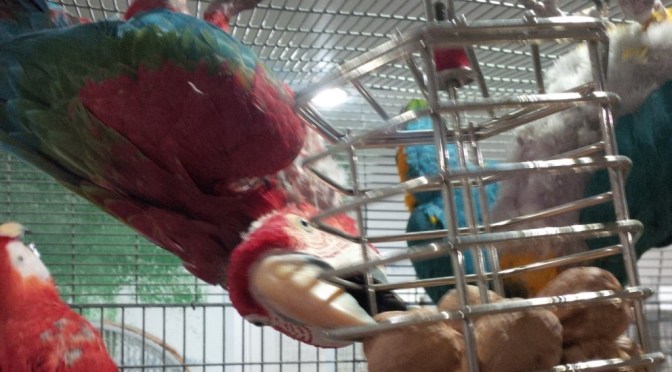
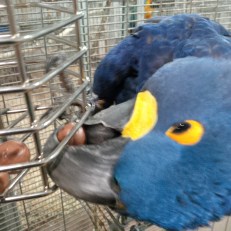
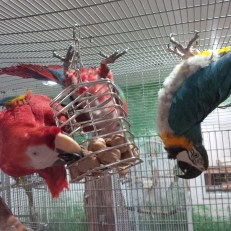
12 beautiful stainless steel “foraging cages”
Wow! What an amazing “care package”! And the timing is truly ideal. Now that it’s cold, our flock will be inside for the winter. As “cabin fever” sets in, our parrots can get bored and cranky. Getting the walnuts out of the foraging cages is a stimulating and fun way for our birds to “forage” for their treats.
We here at Garuda Aviary want to send a BIG thank you and shout out to our heroes, the Parrot Posse and the Caitec Corporation.

IMG_20141207_182130   IMG_20141207_183253

IMG_20141207_183621   IMG_20141207_183052

Omar Transforms

Perhaps you remember Omar from our “Meet the Flock” page. He was the troubled little Lesser Sulfur Crested Cockatoo that had experienced violence at the hands of his owner’s alcoholic father. As a result, he would exhibit symptoms of acute post traumatic stress disorder. For as long as we at Garuda Aviary have known him, Omar would hide in the back of his cage, trembling and afraid.

Barely coping 

As time went on, we learned how to help Omar manage, despite his nearly crippling anxiety. Unfortunately, sometimes anxiety disorders get worse. Omar had never been a feather plucker. But early this spring, Omar began chewing the feathers on his chest. By itself, that is worrisome enough. But this problem took a frightening turn. Omar began to chew a hole in the skin on his chest. His anxiety disorder was quickly becoming potentially dangerous. Sadly, I had to fit him with an E-collar. The collar would keep Omar from mutilating the skin on his chest. But they’re cumbersome and often uncomfortable. In my experience with parrots, I’ve found that once a Cockatoo’s anxiety disorder gets that bad, they typically spend the rest of their lives wearing an E-collar.

Bad to worse

In the months to come, we would try to help Omar cope with his growing ordeal. Much to our collective dismay, it would continue to progress. He would destroy his collars, intent on mutilating his chest. After I replaced his fourth collar with his fifth collar, his disorder reached a grim new level. In an E-collar, Omar couldn’t reach his chest. But he could reach the tops of his wings. So he suddenly began to chew them bloody. My heart sank. When a self-mutilation problem like Omar’s expands to other parts of the body, it’s often only a matter of time before the bird does mortal damage to itself.

Desperately 

I decided to throw every Holistic therapy for anxiety at Omar that I could think of. At this point, I was willing to give him enough Valerian root extract to make him drowsy, just as long as it stopped him from tearing himself apart. In staggered intervals, I began dosing Omar’s water with a few Holistic remedies. One was Valerian root extract. Another was Bach’s Rescue Remedy. But the most impactful was a homeopathic therapy containing four remedies useful for treating nervous tension, anxiety and irritable sleeplessness. This product had a profound effect on Omar’s acute anxiety. Within a week, he had stopped plucking feathers. In another week’s time, it was clear he wasn’t mutilating the tops of his wings or trying to mutilate his chest. He seemed to be doing so well that I decided to remove his E-collar. He was so relieved!

When you remove an E-collar from a parrot, the first thing the parrot is going to do is preen all the feathers it couldn’t reach while wearing the collar. And you must allow the parrot to do so. Otherwise, the areas of un-preened plumage will just drive the poor thing crazy. So you then watch with great apprehension, praying the parrot only preens without plucking feathers or mutilating skin.

Eureka!

In this case, much to my great delight, Omar was only preening. He wasn’t exhibiting the dire pathological behavior. I was amazed. Avian experts generally agree that once a parrot begins to pluck its feathers or mutilate its skin, it is unlikely to stop. My experiences have led me to the same conclusion. So, it seemed these remedies had done the impossible; stopped a ferocious self-mutilator from destroying itself.

But the surprises kept coming…

Not only was Omar suddenly being kind to his plumage and skin, he seemed to be going through a remarkable transformation. Instead of timidly hiding in the back of his cage, he was coming up to the front. Instead of afraid, he was curious, as Cockatoo’s naturally are. He was even beginning to engage socially with humans. Nearly all of our volunteers have commented on how delightfully different Omar is now.

What did it?

The homeopathic remedy compilation consists of:

Avena sativa 2x

Coffea cruda 12x

Passiflora incarnata 2x

Zincum valerianicum 4x

I explained the situation to my homeopathic doctor. He believes Coffea cruda 12x and Zincum valerianicum 4x are the remedies responsible for this stunning change.

Could this be a cure?

With renewed enthusiasm, I am trying these remedies on other parrots with acute anxiety disorders.

Another member of our flock you might remember is Tala, a Moluccan Cockatoo. For years, she has worn an E-collar that prevents her from chewing a hole in her chest. I have tried again and again to wean her out of the collar. But as of yet, she continues to return to the pathological behavior. My homeopathic doctor advised me to be patient regarding Tala’s anxiety disorder. She has spent far longer in an E-collar than Omar has. Her neurosis has had a lot more time to set in.

So I am patient, but no less enthusiastic. It is my hope to single out homeopathic remedies that can effectively treat the anxiety disorders of most parrots.

Stay tuned for new developments, my friends! 

Christopher (Rigdzen) Zeoli

Garuda Aviary

Please note that while Christopher (Rigdzen) Zeoli has nearly 20 years of experience handling and caring for parrots, he is not a certified veterinarian. Nor is he a Homeopathic physician. Also, these holistic remedies have not been evaluated by the FDA for the treatment or cure of disease. If you have a veterinary emergency, please contact a certified veterinarian immediately.

Don’t Throw Me Away

by Christopher (Rigdzen) Zeoli

You don’t have to go far to hear about an animal that has been “thrown away.” But that description is usually exaggerated symbolic imagery for a more mundane example of neglect and abandonment. In this case, the description “thrown away” is literal.
The story you are about to read comes to us from Samantha, a single mother struggling to raise two children with no child support coming in. Samantha and her children depend on every paycheck she brings home. And the apartment building they live in does not allow pets.

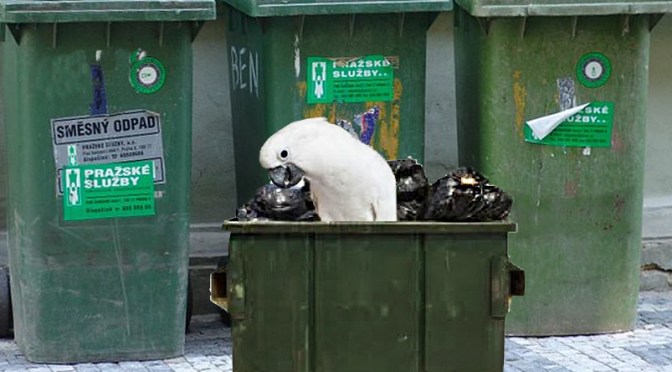
“In March 2012, my daughter and I were leaving the apartment and went outside. We noticed various tenants standing outside surrounding the dumpster. A couple of the local kids had sticks in their hands and were reaching into the dumpster. Curious to see what was all the commotion we walked down to the look inside the dumpster. There was a white Umbrella Cockatoo inside foraging through a garbage bag eating some old food. In that moment my heart sank for the cruelty I was witnessing. Realizing the situation and having some familiarity with parrots I immediately attempted to figure out his disposition. I gave him a toy to test his temperament. He seemed timid and unsure however; he extended his foot and grabbed the toy. He seemed to be enjoying all the attention and I attempted to extend my hand to him to see his reaction. He extended his foot and perched onto my hand. From this point I decided to take him home with me.”

While Samantha’s apartment building does not allow pets, her landlord gave her permission to keep the cockatoo temporarily until she found it a new home. Samantha scoured the Internet looking for any local postings of lost parrots, and to learn more about the type of animal she now had in her home.
“I began researching online and found that often Umbrella Cockatoo’s get passed from home to home and owner to owner stressing and plucking feathers because they are lonely and do not get enough attention from busy owners. I did not want this to be the case with this bird.”

Samantha was unsuccessful in both locating the cockatoo’s previous owners, and in finding it a new home. As time went on, she and her children began to regard this parrot as a family member. As their affection grew, they decided to call him “Coco.”
“(Coco) has been very loving and affectionate towards me and the kids. He has shared in our home life experiences with friends, meals, and outings. However, over the past couple of years, a few things have changed, more so in the past six months, and as my children are now more grown and have become more active outside of the home, they have less time for Coco. Likewise, during the time that we have had him he has gone through various anxiety stages from plucking more feathers, to biting my kids. One bite caused my son to lose an entire fingernail. It took four months to grow back. Coco once walked across the couch and approached my mother, a person who has had significant time with him and is aware of his nature. Coco crawled up her arm to seemingly show affection and then bit her face breaking the skin under her eye. When left for only a few minutes unattended he has ripped holes in my furniture. To my knowledge after researching and consulting with an avian vet, Coco also seems to have reached his sexual maturity which is in or around five years of age and as such has also began to frequently scream as loud as possible for attention. There are times where even when we attempt to show him attention, it is not enough, and for whatever reason he insists on being aggressive with us. This makes living with him and keeping the peace with our surrounding neighbors more difficult and physically more concerning for us at the home. Clearly, this is through no fault of his own and as a wild animal nature compels him to be destructive to keep himself busy and staying entertained. However, due to his sometimes volatile nature, predicting when he will be aggressive towards us has become more and more of a challenge.”

As I am very experienced with parrots, I can tell you that Coco’s behavior is typical for most types of cockatoo. The screaming, biting, feather plucking and destruction of property are all due to anxiety disorders that most parrots develop while living in captivity.  Samantha was facing disturbing and damaging behaviors that are very difficult to manage regardless of what the parrot owner’s living situation is. Her family was repeatedly enduring bite-related injuries. And Coco’s frequent screaming threatened to turn the fear of eviction into a reality.

Coco was unhappy with the confinement of apartment living. And his coping methods were doing damage to Samantha and her family’s home life. With a heavy heart, she contacted Garuda Aviary in the hopes that Coco could live in an environment suited to provide for his unique needs; where he may vocalize as loud and as long as he wants; a place with toys to chew and space to play.
So I am happy to report that Coco will become a member of our flock. And since we already have a bird named Coco, we’re calling this new one Coco2.

I would also like to convey Garuda Aviary’s heartfelt “Thank You” to Samantha and her family for pulling this poor creature from the trash and holding it close to their hearts. For a period of time, you relieved his suffering at no small cost to yourselves. Thank goodness you were there when he needed you the most.

And to future generations and historians, I beg you judge us kindly. I beg this because we will be judged not only for the qualities of our penal system, but also for the lives that we throw away.

___________________________________________________________________

Please consider a donation to help us keep Coco2 and our other parrots sheltered, well fed, and loved.